
Yesterday I saw someone post this image in a KubeSphere group:
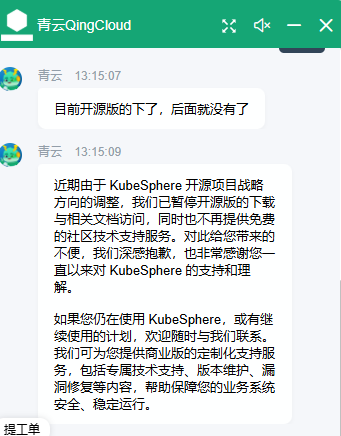
People reported that the official docs suddenly went offline and the mirror download entry disappeared. Other groups quickly erupted, guessing that KubeSphere was going closed source. The forum also had similar posts.
Perhaps due to public pressure, the official team eventually released an announcement on GitHub and other channels.

From community reactions, this move caused strong dissatisfaction. Both community reputation and company reputation declined, and trust was damaged. From this outcome, the move helped no one.
Some people were upset that a working open-source product suddenly went closed. More people were upset that the team silently took down docs and mirrors without notice.
In the issue thread, a foreign user said it was one of the most short-sighted and destructive business decisions they had seen. It damaged reputation, alienated loyal customers, and harmed market position. On a larger scale, it also hurts the reputation of domestic open source in the global community.
The decision is hard to understand.
I joined QingCloud in early 2021 and left in November 2024. During that time I operated the KubeSphere community. 2021 was a peak year for QingCloud: successful IPO and the first hybrid cloud IPO in China. 2021 was also KubeSphere’s fastest growth period. Product, community, and team were all thriving.
Yesterday I chatted with a former colleague. We both felt that those years at QingCloud were joyful and meaningful. After leaving, it felt like drifting. QingCloud could have done even better; it is a pity. Personally I am grateful to QingCloud and KubeSphere for my growth. My former leaders and teammates gave me a lot of guidance and support. I also wrote some community operations articles (all on this blog) as a record of that experience.
Community operations is interesting. The most direct benefit is making friends with contributors: Yin Min, Shu Ge (Ops with Skills), Da Fei, Teacher Haili, and others. The community could not have grown without their support. After I left, most of them gradually moved on to other open-source communities, which is a real regret for me.
But KubeSphere never solved the commercialization problem. A company must survive, and a project must be profitable. If not, it will be cut. Open source is not charity. Under current trends and pressures, commercialization is inevitable.
While working there, I worried about declining interaction and developer participation. I thought about countermeasures and discussed them with the community team. That inspired an article: Concerns About Company-Led Open-Source Projects. It only raised a few questions without deep solutions. What I did not write is the biggest question: if a company stops supporting an open-source product, where does the project go? That is worth thinking about.
I do not intend to criticize my former employer. “Survive” is the top priority. I understand how hard the decision may have been. But giving no buffer period and catching users off guard is hard to accept. It feels like years of reputation were wiped out in a day. Maybe it is easy for me to say, since I was an employee, not a contributor. But for true contributors, is that fair?
Some people say users were freeloading; others say shutting down open source freeloads on contributors. That is reality. I am not a pure open-source idealist, but I know open source needs co-building; a company alone is not enough.
Now KubeSphere users are looking for alternatives or offline packages and docs. The company’s reputation has taken a real hit. It is a lose-lose. A once active, popular, and well-regarded open-source project may be fading.